
Innovation is no longer optional — it is essential.
By 2026, students entering higher education and the workforce will compete in environments shaped by artificial intelligence, automation, biotechnology, and rapid technological change.
To prepare them effectively, schools must go beyond theoretical science and mathematics. They must foster innovation through practical, creative, and interdisciplinary STEM education.
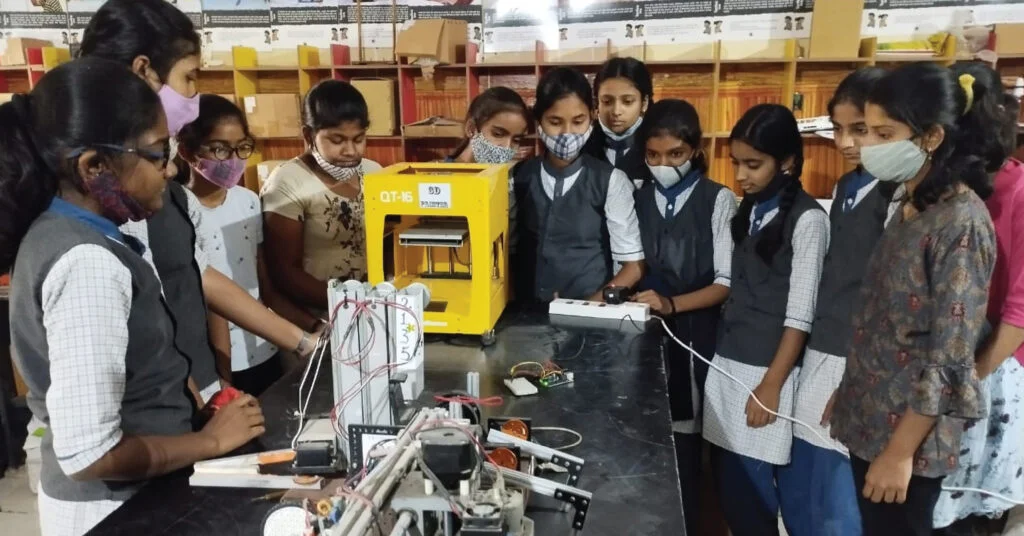
STEM (Science, Technology, Engineering, and Mathematics) becomes powerful when it shifts from textbook knowledge to real-world experimentation.
1️⃣ Turning Curiosity into Creation
True innovation begins with curiosity.
Instead of simply teaching formulas or definitions, classrooms should encourage students to:
- Build prototypes
- Conduct hands-on experiments
- Design engineering models
- Test hypotheses
This practical approach aligns naturally with Project-Based Learning in Modern Classrooms, where students actively apply concepts rather than passively memorizing them.
When students build something tangible, learning becomes meaningful.
2️⃣ Strengthening Critical Thinking Through Scientific Inquiry
STEM education develops structured reasoning.
Students learn to:
- Analyze data
- Identify patterns
- Test solutions
- Evaluate outcomes
These processes directly enhance Critical Thinking & Problem-Solving Skills, which are essential for navigating complex global challenges.
Innovation is not random creativity — it is informed experimentation.
3️⃣ Encouraging Creative Confidence in Technical Fields
Many students believe creativity belongs only in arts and humanities. In reality, innovation requires imagination across disciplines.
By integrating design thinking, robotics, coding, and experimentation into STEM programs, schools support Building Creative Confidence in Students.
Students begin to see themselves not just as learners — but as creators and problem-solvers.
Creative thinking drives technological breakthroughs.
4️⃣ Preparing Students for an AI-Driven Future
Modern STEM education must include exposure to emerging technologies.
Students should understand:
- Basic coding logic
- Data interpretation
- Robotics fundamentals
- Artificial intelligence concepts
Embedding these skills into Digital & AI Literacy in Education ensures students are prepared not only to use technology, but to innovate within it.
The goal is not just digital familiarity — it is technological leadership.
5️⃣ Building Communication & Collaboration in Innovation
Innovation rarely happens in isolation.
Students working on STEM projects must:
- Present findings
- Explain complex ideas simply
- Collaborate in teams
- Share feedback constructively
These experiences strengthen Building Communication Skills from an Early Age, preparing students to lead technical teams in the future.
Clear communication amplifies innovation.
6️⃣ Encouraging Resilience and a Growth Mindset
Innovation includes failure.
Experiments may not work. Prototypes may collapse. Code may contain errors.
By promoting a Growth Mindset Culture, schools teach students that setbacks are part of discovery.
Resilience is a defining characteristic of successful innovators.
Students who learn to iterate, improve, and persist become future leaders in science and technology.