
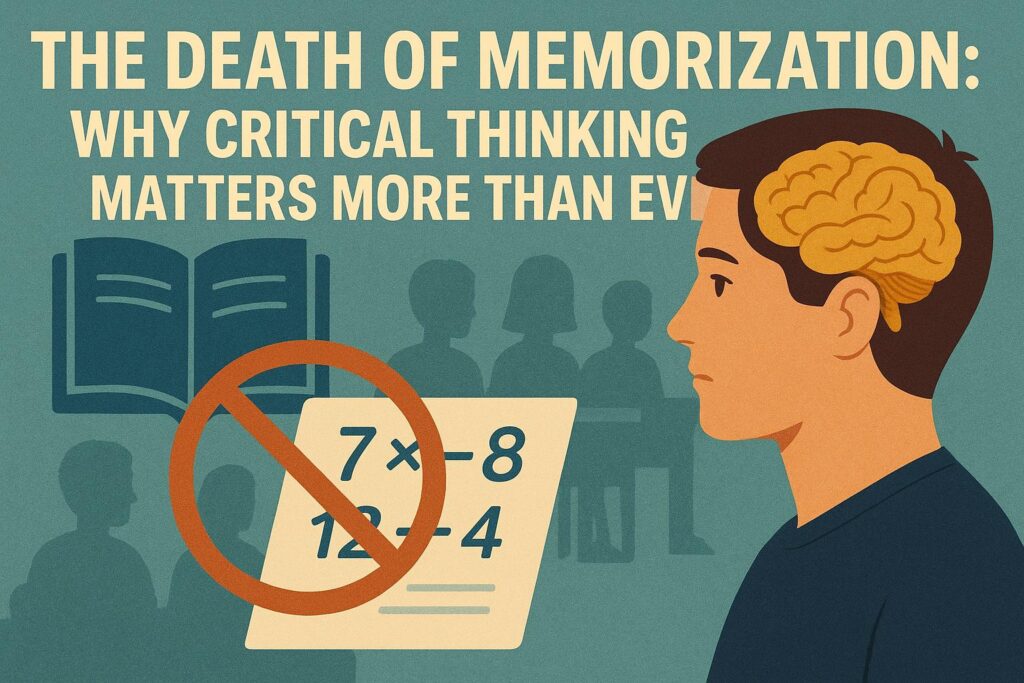
In an age where information is available instantly, memorization is no longer the defining marker of intelligence.
Students today can access facts within seconds. What sets them apart is not what they remember — but how they interpret, question, and apply information.
That is the power of critical thinking.
As we prepare students for 2026 and beyond, schools must shift from content-heavy learning to thinking-centered education.
1️⃣ Moving Beyond Rote Learning
Traditional education systems often reward repetition. While foundational knowledge is important, relying only on memorization limits deeper understanding.
Instead, classrooms must encourage:
- Analysis over recall
- Application over repetition
- Exploration over fixed answers
This transition supports Building Creative Confidence in Students, because students feel empowered to think independently rather than simply repeat information.
When learners realize their opinions and reasoning matter, confidence grows.
2️⃣ Encouraging Question-Driven Classrooms
Critical thinking begins with curiosity.
Teachers can design lessons that:
- Invite debate
- Present real-world case studies
- Compare multiple perspectives
- Ask students to defend their reasoning
This approach aligns closely with Inquiry-Based Learning Strategies, where students actively construct knowledge instead of passively receiving it.
When questioning becomes normal, deeper understanding follows.
3️⃣ Strengthening Problem-Solving Through Projects
Students develop analytical skills when they work on real-world problems.
By integrating Project-Based Learning in Modern Classrooms, schools allow learners to:
- Break complex issues into smaller parts
- Evaluate different solutions
- Collaborate to refine ideas
- Reflect on outcomes
Projects create space for experimentation and reasoning — both essential for critical thinking.
4️⃣ Preparing Students for an AI-Driven World
With artificial intelligence becoming part of daily life, students must learn to evaluate digital information critically.
They need to:
- Identify misinformation
- Understand bias in data
- Use AI tools responsibly
- Make ethical decisions
Developing Digital & AI Literacy in Education ensures students are not just consumers of technology, but thoughtful users.
Critical thinking becomes the filter through which students navigate the digital world.
5️⃣ Building Emotional Intelligence for Better Judgment
Strong thinking skills are connected to emotional awareness.
When students develop Emotional Intelligence in Students, they:
- Manage disagreements respectfully
- Listen actively
- Consider different viewpoints
- Make balanced decisions
Critical thinking is not only logical — it’s also empathetic.
Understanding emotions strengthens reasoning and collaboration.
6️⃣ Fostering a Growth-Oriented Mindset
Students must understand that thinking skills develop over time.
By promoting a Growth Mindset Culture, schools teach students that:
- Mistakes are learning opportunities
- Feedback improves reasoning
- Persistence strengthens analysis
When students are not afraid of being wrong, they are more willing to think deeply.